Field dispatch
Six Eggs in the Cup: Three Days on the Bookshelf Nest
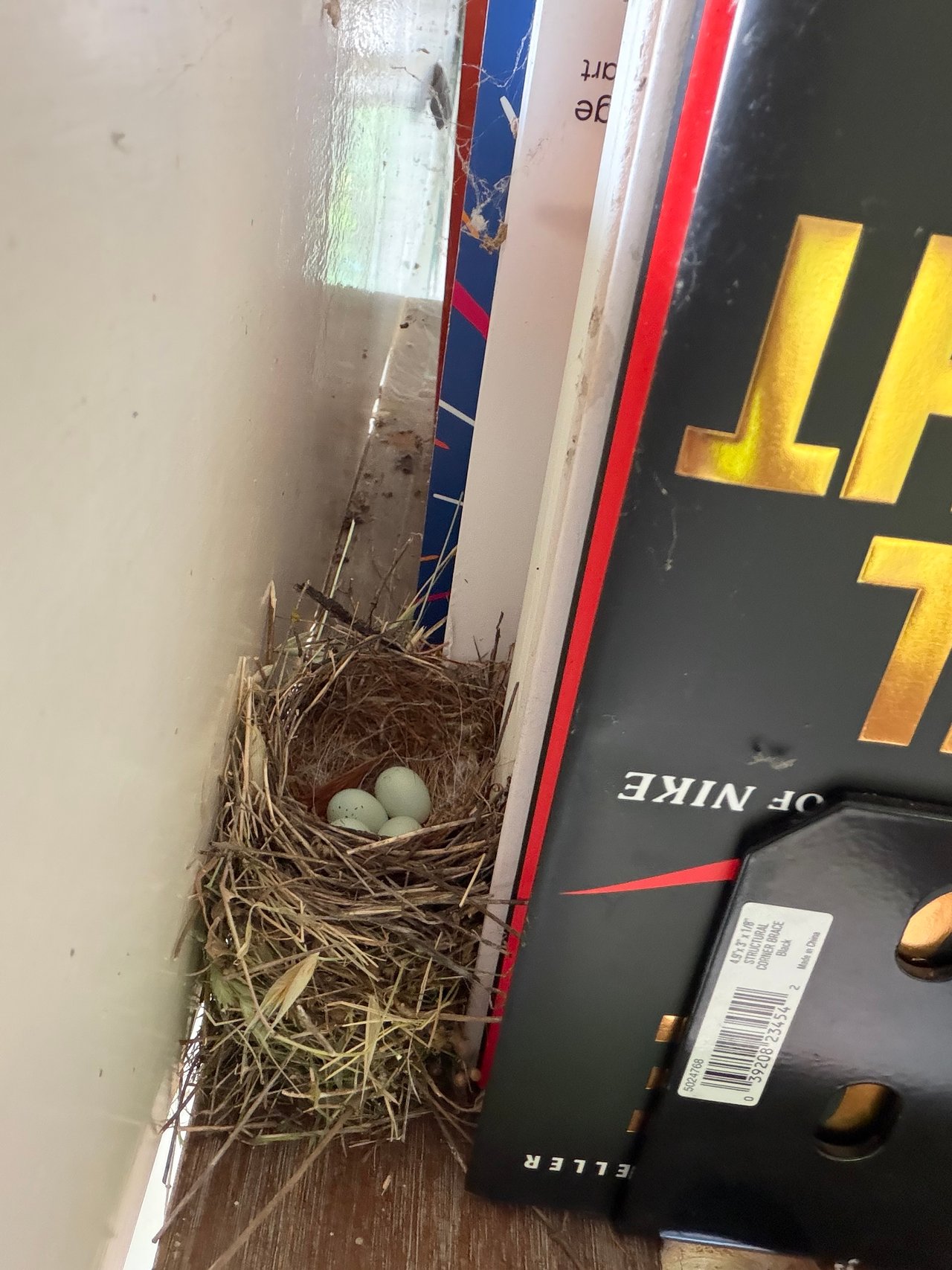
Some nests announce themselves. This one hid inside a domestic interior, its dried-grass cup wedged between a dark spine — a copy of Shoe Dog standing as a windbreak — and the white wall of a sunroom. My first close look came Saturday afternoon, April 25, when I found the female off the eggs. A quick burst of iPhone frames from multiple angles recorded two, sometimes three, sometimes four pale blue-green eggs with dark speckles, depending on how much the rim overhang obscured the clutch. That variance is instructive: the cup has steep walls and any lateral shot will occlude the rearmost eggs. The honest figure for Saturday afternoon is at minimum two eggs confirmed, with camera geometry preventing an unambiguous total.
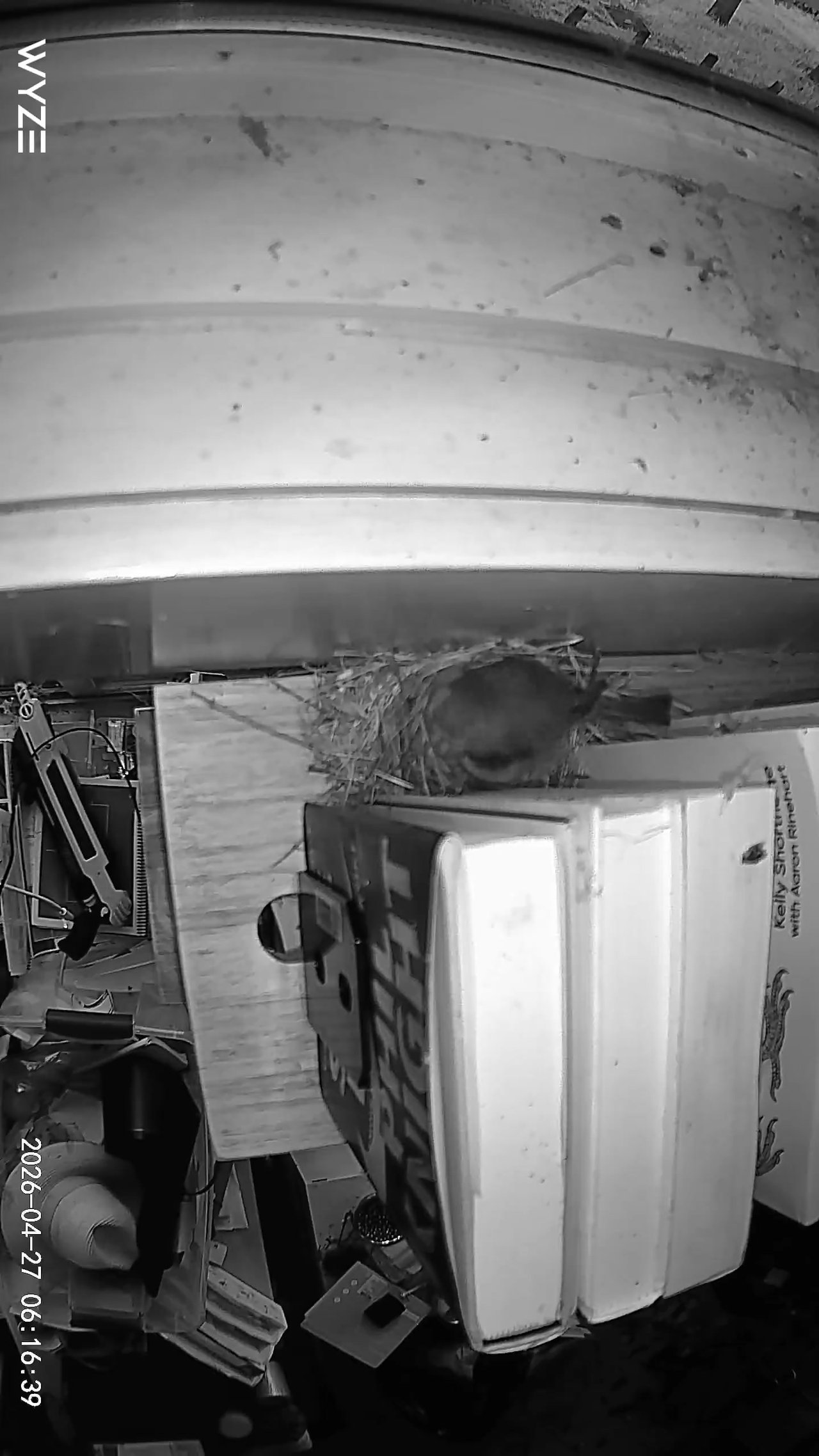
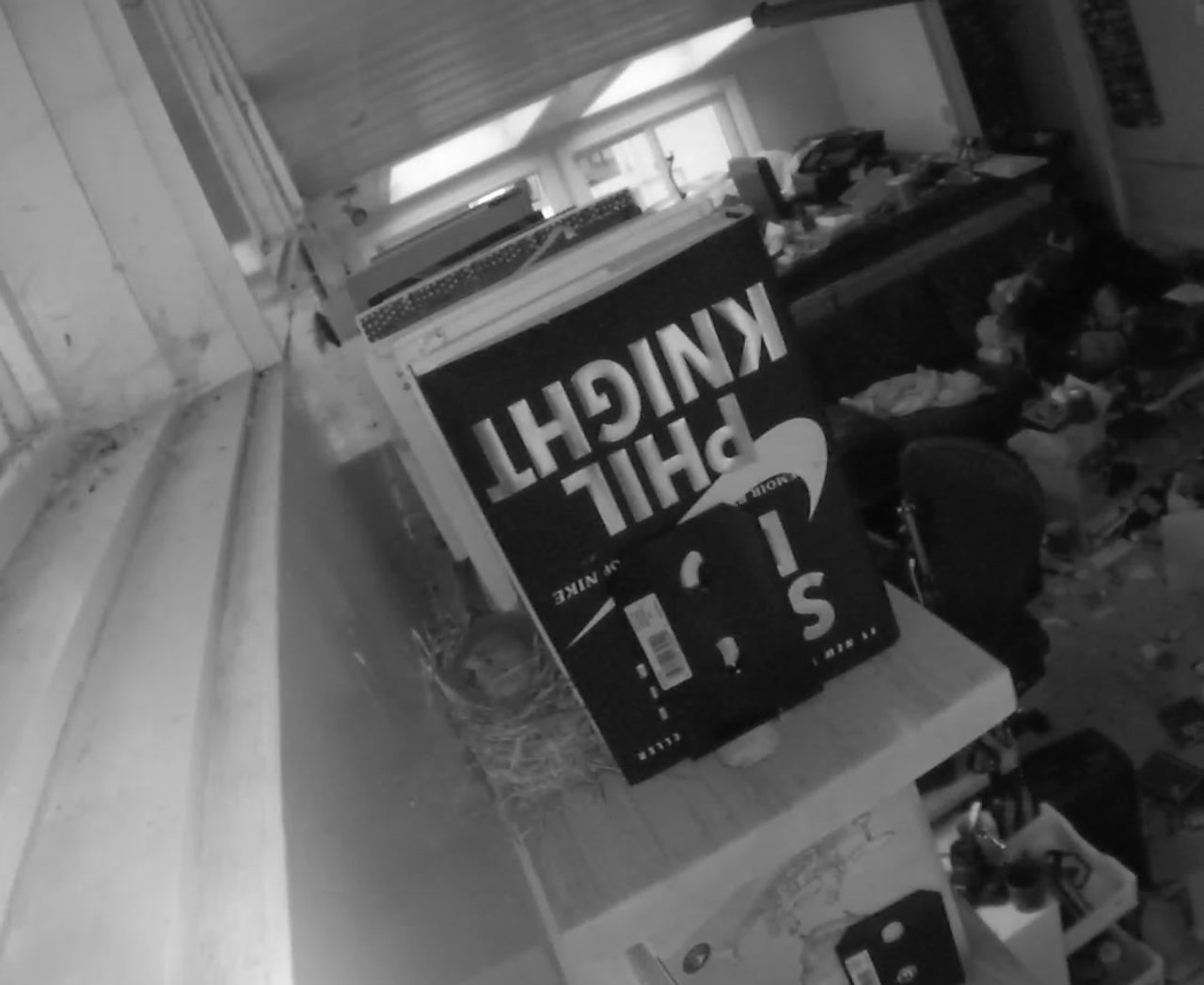
By 21:13 that night the IR camera showed the female settled low in the cup, her body filling it, head tucked. The bookshelf camera confirmed her still there at 22:16.
Overnight incubation had begun. House Finches typically commit to the cup around the penultimate egg, and this female’s behavior tracks that pattern precisely — settling in for the night while laying likely continued into the following days.
Sunday, April 26, filled in the behavioral portrait with the male. He appeared at 13:41, perched on the books directly above the cup, studying it from above, then again at 13:42 just below. His red crown and chest — vivid even in the camera’s monochrome rendering — identified him without ambiguity. He returned at 18:19 and again at 20:07, each time hovering near but not entering the cup. The female’s pattern on Sunday was a series of shorter bouts: off the eggs through much of the morning, settled mid-day, and flushed briefly when a person leaned over the shelf around 13:28, but she did not abandon. That tolerance — sitting tight while humans moved within arm’s reach — reflects a level of habituation that takes days to earn. By 20:03 she had settled in for the night.
Monday, April 27, provided the most complete record of the three days, and with it the full clutch count. Wyze camera clips at 13:28 and 13:29 show — clearly, the cup filling the frame — six pale oval eggs. The NIR-albedo of those shells registers distinctly higher than the surrounding dried grass: each frame shows the eggs standing out as high-reflectance objects, their smooth surfaces scattering near-infrared illumination back into the sensor in a way the fibrous nest material cannot. A Wyze clip at 15:34 confirms six eggs again, the female arriving, settling briefly, then departing. A clip at 17:15 records five eggs visible with the female perched on the shelf facing away — one egg tucked behind the cup rim, the same geometry problem as Saturday.
The arc across these three days is one of escalating commitment. Saturday evening marked the turn toward sustained overnight incubation. Sunday established the male’s orbit and the female’s tolerance of disturbance. Monday confirmed the full clutch and the feeding rhythm that will define the coming fortnight: the male arrives in tight clusters — two or three visits within minutes — then an hour-long gap, then another cluster. This triple-visit cadence, documented at 15:34 and again at 17:15–17:17, is his food-delivery signature: quick passes to provision the brooding female so she need not leave the eggs for long.
Six eggs in a grass cup on a bookshelf. If the last was laid on or around April 27 and incubation runs the typical twelve to fourteen days, the hatch window opens somewhere around May 9–11. The pale blue-green shells — their NIR-albedo the brightest feature in every frame — will grow less reflective as the embryos develop and the shells begin to thin. Right now they catch every photon the camera throws at them. In two weeks, all being well, the cup will hold something noisier than eggs.