Field dispatch
The Male Keeps Returning to the Cup, Day After Day
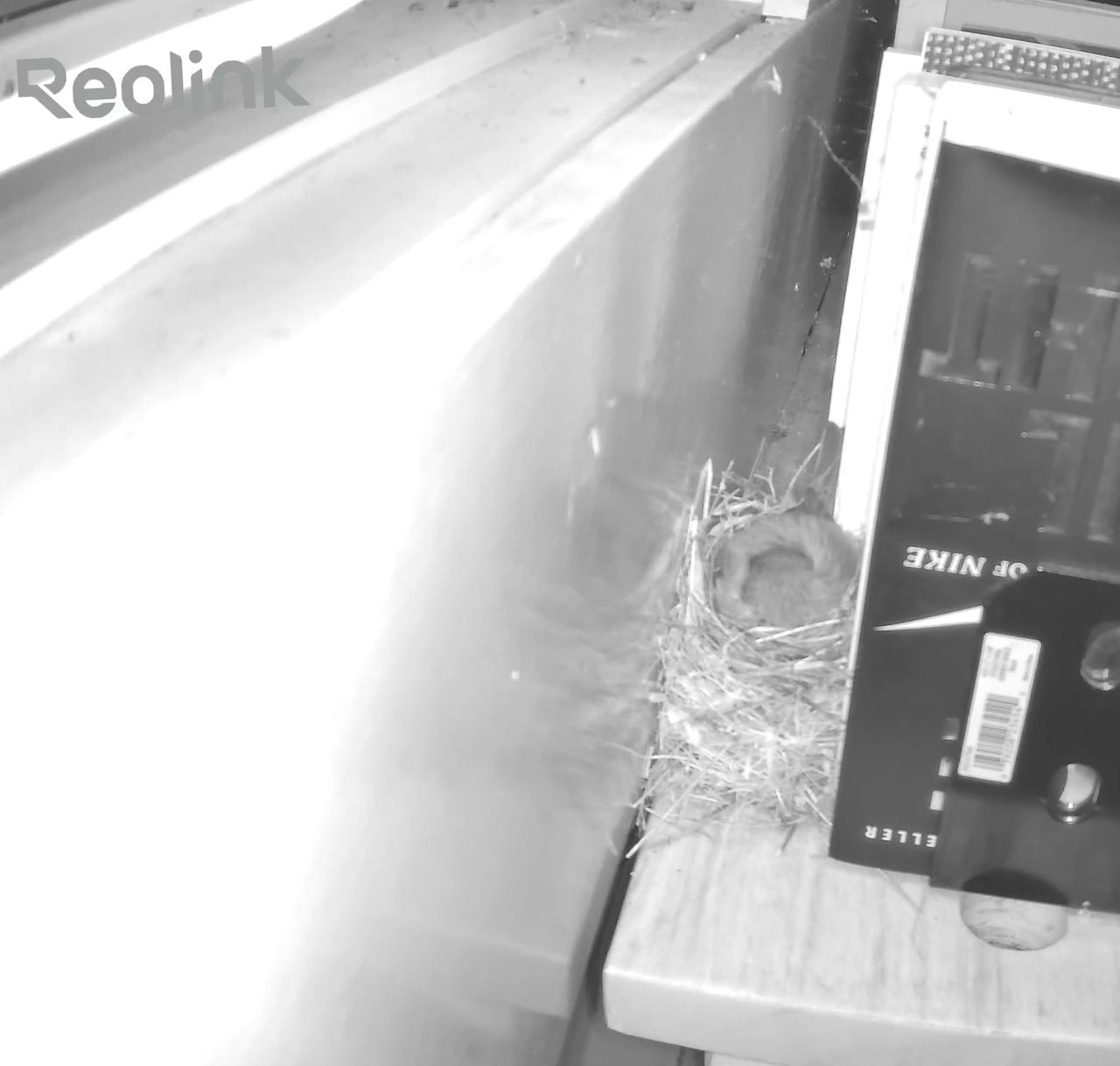
Three days into close observation of the House Finch nest in the sunroom, the clearest thread running through the record is not the female’s steady incubation — that is expected — but the male’s repeated, sometimes extended presence in the nest cup itself. This is the anomaly worth tracking.
May 1 — Friday
The female cycled through the cup through the overnight hours in intervals ranging from fifteen to forty-five minutes, both eggs exposed during each gap. By midmorning the male had arrived on multiple occasions, and what distinguished today from ordinary courtship-feeding behavior was that he settled into the cup — not merely delivering food at the rim or perching on adjacent books, but occupying the incubation bowl itself. At 14:59, with the nest briefly empty, the camera captured both eggs clearly: small ovals whose speckled, high NIR-albedo surfaces stood out against the woven grass floor. By 16:10 the female had returned, tucking them beneath her, and the male was visible on the ceiling-fan rod in the background — watching, not competing.
The evening brought a stranger observation. At 20:08:19, the cup was empty and both eggs were visible. Sixty seconds later, at 20:09:09, the male had just departed the rim and the camera caught what appeared to be a small, downy figure with closed eyes in the cup — potentially a very newly hatched chick. The female arrived within moments and covered the cup. The image is ambiguous enough to withhold a firm call, but it deserves noting.
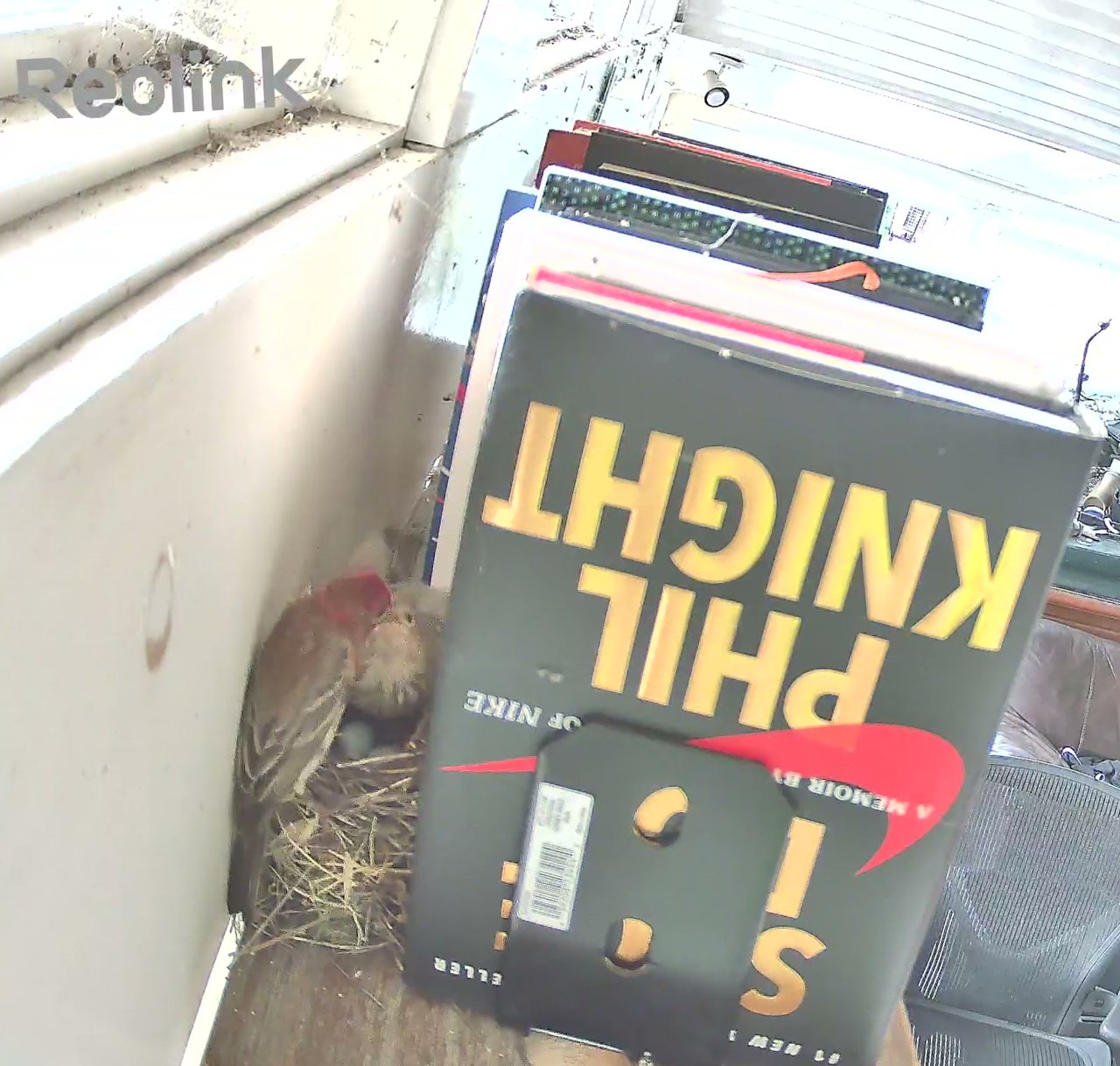
May 2 — Saturday
Saturday settled into a more legible rhythm. The female was deep in the cup by mid-morning, her plumage showing an unusually pronounced red wash at crown and chest — a feature more typical of males, worth flagging as an individual variation to watch for in future identifications. The male appeared at 13:50 for a classic courtship feeding, perching on the books beside the nest while she sat; he was back in the cup at 17:55 and again at 19:34, continuing the cup-sitting pattern established the day before.
Two eggs remained visible in the afternoon empty-nest frames, consistent with May 1. At 17:21 a human moved close to the nest; the Wyze camera produced a corrupted, overexposed frame carrying a timestamp of 2026-05-07 — almost certainly a clock glitch triggered by the jostled camera. The female returned by 17:41 without apparent distress, and from 19:54 onward she held position continuously through the IR shift, barely moving until well after the sunroom lights were out.
May 3 — Sunday
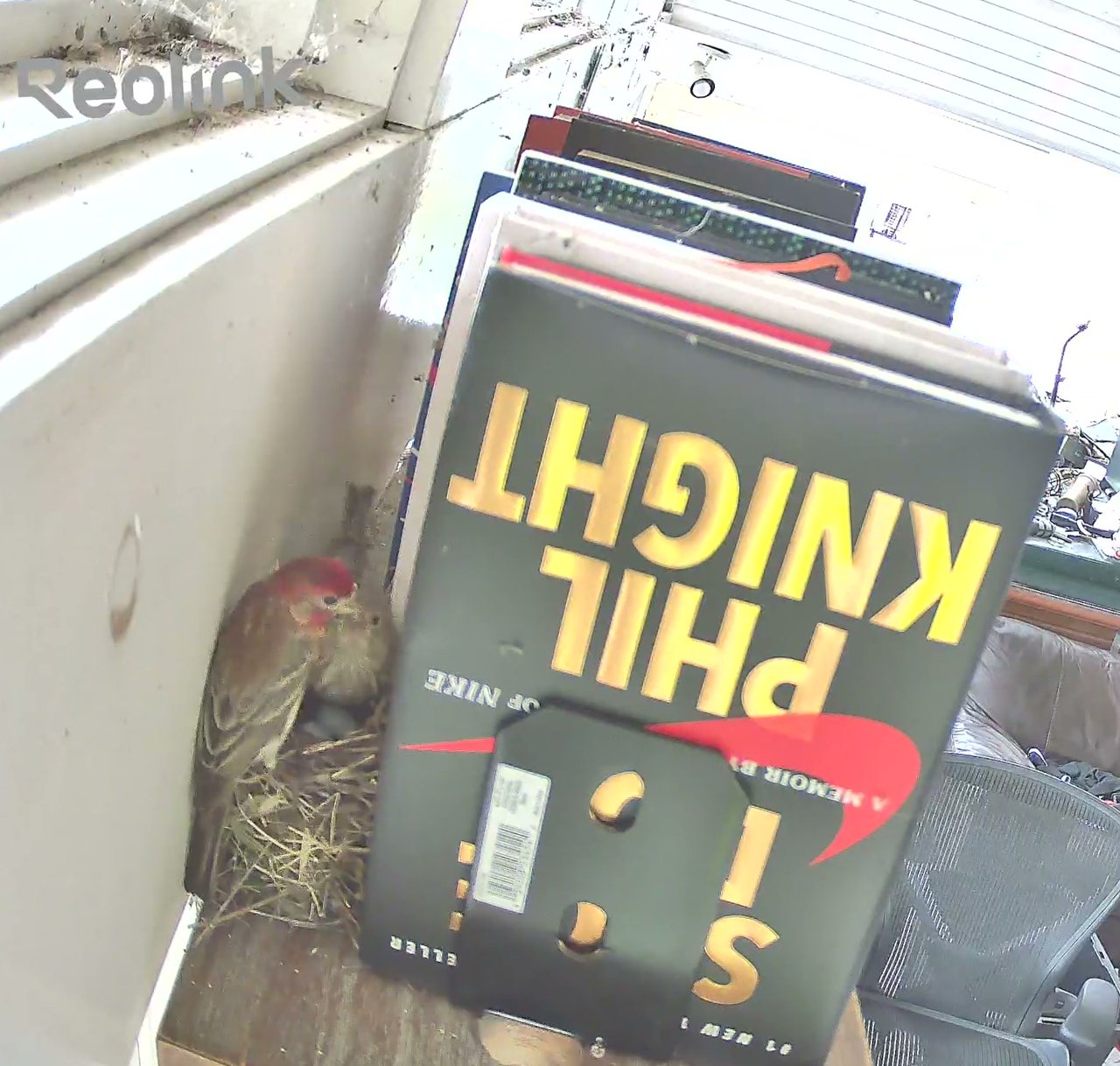
Sunday extended both patterns with striking regularity. The female was on the nest at 02:00; the first male visit came at 08:37, and a cluster through the morning — 09:29, 10:26, 10:27, 11:42, 11:43 — reproduced the rhythm of the previous two days almost exactly. His approach has become recognizable: land on the shelf or adjacent book, move to the rim, occasionally drop into the cup for a frame or two, then depart while she resumes. At 14:16 he occupied the cup for two frames before she took over; at 16:28, she was on the shelf below while he sat briefly in the cup above.
In late afternoon, the empty nest before her 17:26 return showed two eggs. The same count held at 18:42. At 20:09, after she rose and the male made a brief rim visit, only one egg was visible in the cup. One minute later the single pale oval remained but no second egg appeared in frame. Whether the other had shifted outside camera angle or something else occurred is unresolved. A human had moved through the sunroom during the 19:54–20:03 window — a coincidence worth monitoring closely.
Pattern across three days
The male’s cup-sitting — most dramatic on May 1, documented again on May 2 and May 3 — is the through-line of this period. House Finch males do not typically incubate; courtship feeding at the rim is the expected behavior. What the camera shows is something slightly beyond that: brief but repeated occupancy of the incubation position itself. Whether this reflects an unusually attentive male, an incomplete behavioral boundary, or something particular to this nest situation is not yet clear.
The confirmed egg count from raw descriptions held at two throughout — two on May 1, two through most of May 2 and May 3 — with a single-egg reading at the close of May 3. The possible chick glimpsed on May 1 evening, if genuine, would place hatching on the first day of this record and make the subsequent two-egg readings the remaining unhatched clutch. The next unobstructed empty-nest view will be the telling frame.