Field dispatch
Outgrowing the Cup: Five Fledglings on Day 28
Field Journal — House Finch Nest, 22 May 2026
The cup has not changed since hatch. Five birds have. The vessel that once held five pale eggs and one adult now contains five well-feathered fledglings, bodies overlapping, tails crossed, occupying every cubic inch of available space. The 21st described chicks “beginning to overflow.” On the 22nd the overflow is the resting state. The nest is the same nest; the brood is no longer the same brood.
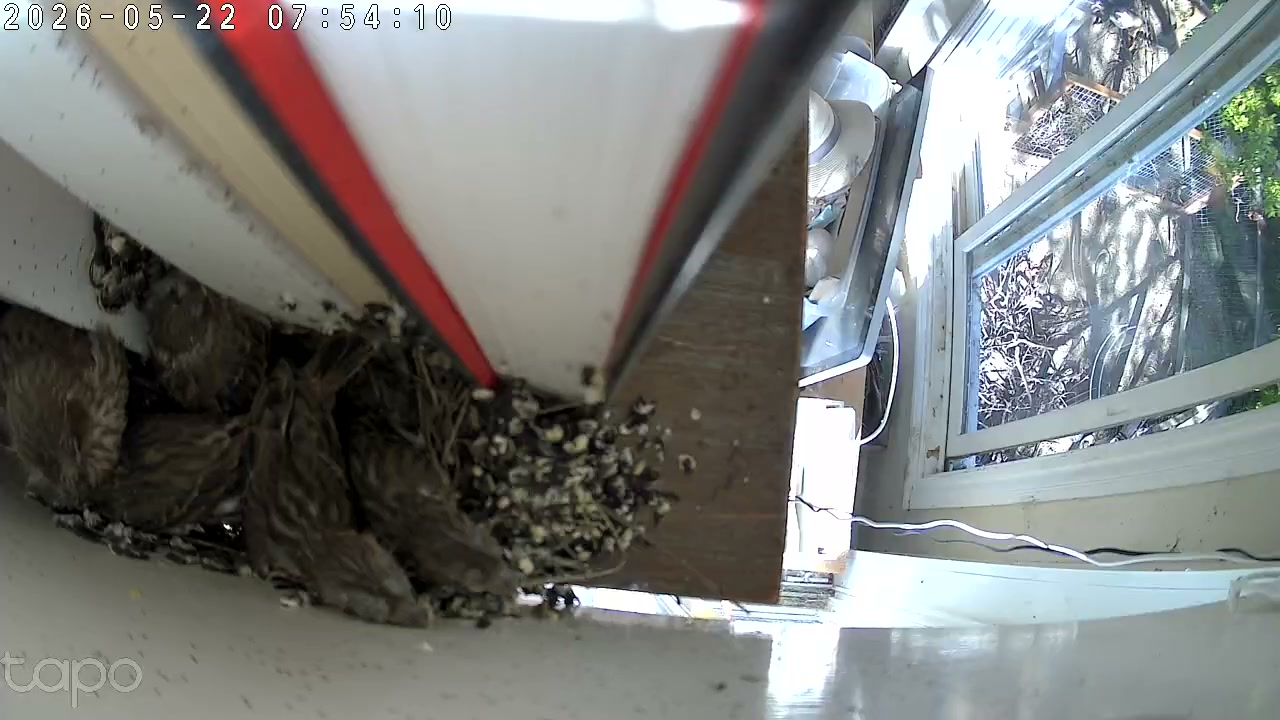
The first chick-visible frame of the day appears at 00:01, ninety seconds after midnight, in IR. By 07:43 the full daylight configuration is established: multiple feathered juveniles tightly pressed into the cup, no adult visible, the cup itself a brown overlapping mass with little nesting material showing through. Across the day, of 1,134 Tapo motion clips between 00:01 and 23:02, 877 — roughly seventy-seven percent — are tagged empty_nest by the classifier. The label refers to the absence of a visible adult, not to an absence of birds. The cup is rarely empty; the cup is rarely uncrowded.
At 09:51, a curious intermediate moment: two birds resolve in the immediate cup zone, one larger and more centrally positioned than the other. Whether the second is an adult or a sibling cannot be determined from a brown-on-brown frame in compressed daytime video, but the geometry is recorded.
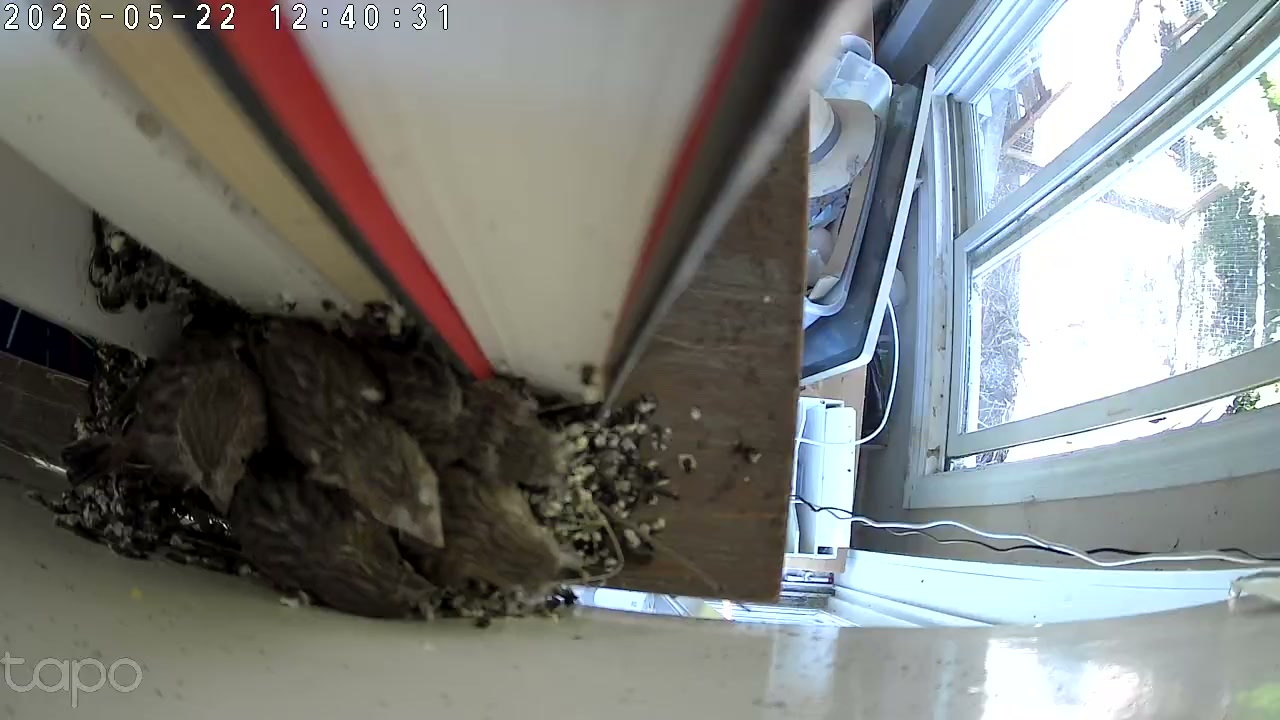
The signature frame of the day is captured at 12:40. Five large, well-feathered juveniles are packed wall-to-wall inside the cup footprint — no individual chick fully distinguishable from the others, the cup material indistinguishable from the birds occupying it. The image reads as one continuous mass of fledgling rather than a cup with five chicks inside. The classifier’s caption for this clip — “filling the nest cup and spilling onto the shelf” — accurately registers the visual sense that the cup can barely contain its contents, even where the camera angle makes it ambiguous whether any individual chick has actually crossed the cup boundary. The fledglings are big. The cup has not gotten bigger.
The day’s real story, however, is not spatial. It is metabolic. The male’s confirmed visits drop to twenty-three across the day, down from much denser clusters earlier in the brood period, and the median interval between observed visits widens to thirty-eight minutes. The longest gap between visits is two hundred and twenty-nine minutes — three hours and forty-nine minutes — a span unimaginable two weeks ago, when these same birds were naked and dependent. They are no longer either. Five well-feathered juveniles can hold a body-temperature equilibrium for hours without parental subsidy; the widening of feeding intervals is not negligence but recalibration. The brood now produces enough heat on its own, so the parents no longer have to.
This is the quieter, less photogenic side of fledging — the parental side. Before any chick takes a first flight, the adults back off. Visits widen. The chicks learn to feel the absence and respond to it. By the time wings carry them clear of the nest, the dependency that once made absence threatening has already been substantially weaned. May 22nd is a day in that weaning: not the day of departure, but a day of recalibration toward it.
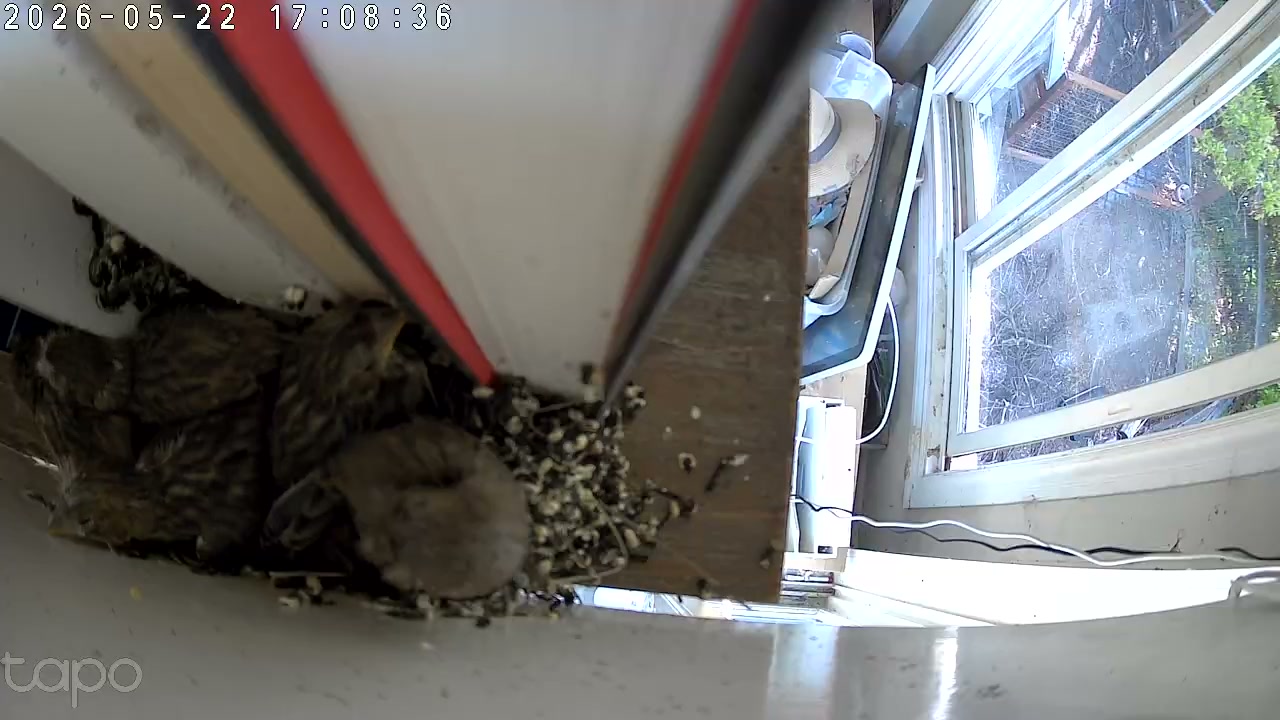
By 23:02 the last chick visibility of the day is logged. The configuration that began as five small naked bodies in a closed cup on May 7th has resolved into five large feathered juveniles still occupying that same cup, sixteen days later — visibly outgrowing it but not yet leaving. The next observable transition will be one of them, or several, on a wing.